Showing posts with label India. Show all posts

Tuesday, 6 January 2015

Murder Case Registered Over Sunanda Pushkar Death

Sunanda Puskhar Tharoor (R), wife of India's Minister of State for Human Resource Development Shashi Tharoor, poses with her husband at the Indian F1 Grand Prix at the Buddh International Circuit in Greater Noida, on the outskirts of New Delhi, October 27, 2013. — Reuters/file

NEW DELHI: Indian police on Tuesday registered a murder case against unknown persons over the death of Sunanda Pushkar, claiming the wife of the Shashi Tharoor was killed by poisoning, according to a Times of India report.


"We have got the final medical report from AIIMS, and we have been told that it was an unnatural death... It was not a natural death," Delhi Police chief B S Bassi told mediapersons.

"Sunanda died due to poisoning. Whether the poison was given orally or injected into her body is being investigated," he said adding that the report from the All India Institute of Medical Sciences (AIMS) was received on Dec 29.


“We can only say which substance caused the poisoning after further investigation,” Bassi further said adding that, "For that we will send her viscera abroad."

Pushkar was a Dubai-based entrepreneur before she married Shashi Tharoor in 2010.

 She was found dead in a five-star hotel in New Delhi under mysterious circumstances on Jan 17 last year, a day after she had accused Pakistani journalist Mehr Tarar of “stalking” her husband and of trying to “break” her marriage when she was away for medical treatment for three months.

Tarar had denied Pushkar’s accusation of an affair between her and the former high-flying UN diplomat.

Monday, 5 January 2015

World Cup 2015: Former stars back in the mix


First they lit up the ICC Cricket World Cup stage with bat and ball, now these former players are guiding the current generation of cricketers towards the ultimate prize.


These former superstars will now take on coaching duties at the 2015 tournament:

Pakistan: Waqar Younis (coach), Grant Flower (batting coach) and Mushtaq Ahmed (spin coach)

Pakistan head coach Waqar Younis knows what it is like to be part of a World Cup.

The quickie was a part of Pakistan’s 1996, 1999 and 2003 squads, playing 13 matches and taking 22 wickets.

Younis is joined by batting coach Grant Flower, who scored 512 runs in 21 World Cup matches for Zimbabwe in the 1996, 1999 and 2003 tournaments.

Spin coach Mushtaq Ahmed has also seen his share of Cup action, playing 15 matches for Pakistan in 1992 and 1996. His finest moment came in the 1992 final where he picked up 3-41 to help lead Pakistan to its first World Cup crown.

Australia: Darren Lehmann (Coach):

 The man affectionately known as ‘Boof’ will be in a perfect position to prepare his charges for the 2015 World Cup, having played 19 matches in the 1999 and 2003 tournaments.

His World Cup honour roll includes 360 runs in 16 innings at an average of 32.73.

Lehmann’s best knock was in 1999 against New Zealand, when he scored 76, while he also picked up 2/22 against Kenya in 2003 with his handy left-arm orthodox.

A member of two Australian World Cup champion teams, Lehmann will no doubt be keen to add to the trophy cabinet in March.

Bangladesh: Chandika Hathurusingha (coach), Heath Streak (bowling coach) and Ruman Kalpage (fielding coach)

There is plenty of World Cup experience in Bangladesh’s coaching panel. More than 30 matches worth, in fact.

Head coach Chandika Hathurusingha played four Cup matches for Sri Lanka in 1992, taking a total of five wickets. His standout game was against West Indies when the allrounder snared 4/57.

Meanwhile, bowling coach Heath Streak brings by far the most experience to the coaching line-up. The Zimbabwe allrounder played 22 matches across the 1996, 1999 and 2003 tournaments, taking 22 wickets and scoring 328 runs.

He captained eight matches during the 2003 tournament, while his best performance with the ball at Chelmsford in 1999, taking 3/35 against South Africa. Playing New Zealand in 2003, Streak produced his best knock – 72* from 84 balls.

Bangladesh fielding coach Ruman Kalpage represented Sri Lanka in seven 1992 World Cup matches.

India: Duncan Fletcher (coach)

World Cup fans would have fond memories of Duncan Fletcher leading Zimbabwe to an upset victory over Australia during the 1983 tournament. In Zimbabwe’s first World Cup match, Fletcher scored an unbeaten 69 before taking 4-42 to mastermind a memorable win for Zimbabwe over Australia.

It was one of six World Cup appearances Fletcher made for Zimbabwe. The Former all-rounder and Zimbabwe captain was named coach of India in 2011, replacing Gary Kirsten.

Ireland: Phil Simmons (coach)

Ireland has only played in two World Cups to date but already have some impressive scalps including Pakistan and England.

They will be coached by former West Indies all-rounder Phil Simmons in the 2015 tournament.

Simmons, who took over the role after the 2007 tournament, played more than 140 ODIs for West Indies and was part of the 1987, 1992 and 1999 Cup squads.

In 13 World Cup matches, he scored 336 runs at an average of 30.55 and took eight wickets at 28.38.

New Zealand: Shane Bond (bowling coach)

New Zealand’s bowlers will head into the 2015 World Cup under the tutelage of former New Zealand speedster Shane Bond.

Bond was part of New Zealand’s World Cup squads in 2003 and 2007.

In a memorable outing at Port Elizabeth in 2003 he picked up 6-23 against Australia, including the scalps of Adam Gilchrist, Matthew Hayden, Ricky Ponting and Damien Martyn.

Scotland: Paul Collingwood (assistant coach)

Scotland want to make a splash at its third World Cup and have secured the services of former England batsman Paul Collingwood to aid their mission.

Collingwood donned the coloured clothes for England on 197 occasions, including 18 times at the 2003, 2007 and 2011 World Cups.

His 474 tournament runs came at an impressive average of 39.50.

Collingwood, who took temporary charge of the team earlier in 2014 and helped guide Scotland to qualification for World Cup, will help head coach Grant Bradburn for the World Cup campaign.

South Africa: Allan Donald (bowling coach)

South Africa’s fearsome bowling line-up boasts the likes of Dale Steyn, Vernon Philander and Morne Morkel.

The imposing attack is under the guidance of a man who took part in four World Cups – Proteas legend Allan Donald.

The paceman was part of the 1992, 1996, 1999 and 2003 tournaments, picking up 38 wickets in 25 matches at an average of 24.03.

Sri Lanka: Marvan Atapattu (coach)

Sri Lanka’s head coach scored plenty of runs in his 15 World Cup matches.

Part of the 1999 and 2003 squads, Marvan Atapattu blazed 521 World Cup runs at an average of 43.42.
The batsman has previously coached Canada and Singapore and was appointed Sri Lanka coach in April 2014.

UAE: Aaqib Javed (coach)

United Arab Emirates returns to the Cricket World Cup for the first time since 1996 and will be led by a man who knows what it is like to win cricket’s most coveted prize.

Head coach Aaqib Javed was part of Pakistan’s 1992 World Cup winning team. He played 15 Cup matches in the 1992 and 1996 tournaments, picking up 18 wickets.

West Indies: Richie Richardson (coach)

West Indies haven’t made the semi-finals of the World Cup since 1996.

Former batsman Richie Richardson was captain of that team and will be keen to see his men repeat that form when he leads them into the 2015 tournament as head coach.

Richardson’s 244 ODIs for West Indies included appearances at the 1987, 1992 and 1996 Cups. In 20 World Cup matches, Richardson racked up 639 runs at an average of 37.59 with a highest score of 110.
ICC Media

India and Pakistan: The fault is not in our stars

In the hands of zealots and fanatics, the stories become an argument against all peace initiatives, making the journey all the more strenuous. —Reuters


“The fault, dear Brutus”, Cassius says in Shakespeare’s Julius Caesar,” is not in our stars, but in ourselves”.
Years and years of ‘Aman ke Aashas’ and cabinet level meetings, of confidence-building measures and sari exchanges, of showing up at swearing-in ceremonies and civil society initiatives ... and then they all come tumbling down.

Slowly, painfully, assiduously we pick up the beads and start threading them. Each pearl is accounted for, each step pondered over, but then one slip and the process has to start afresh.

Extravagant, excessive preparations are made to make an omelet of reconciliation. Then a singular egg turns out to be bad, and the food gets spoil.

It is not that we do not comprehend the need to establish friendly relations. The inevitable falling back to the narratives of peace and of building goodwill, the talks of overcoming the barriers and the friendly gestures all betray the understanding of the necessity of peace that persists among members of the public. If there was a lack of will, these processes would never have initiated, ab initiation.

When the anger subsides, the realization returns that belligerence is not a sustainable model; it cannot persevere, it has to stop.

Why, then, do these initiatives fail time and again?


It is because the animosity is too deep, the sentiments too fragile, the composure too fickle and the hurdles too many. It is this peculiarity which exists in men the world over, but most of all in the men of the subcontinent – the unyielding hubris, and the vanity. That is all it takes to lose focus of the objectives.

All it requires is one Vikram Sood and one Amir Liaqat, and a single moment of commentary in the presence of a jeering, thumping crowd.

All it demands is a single brainwashed soldier, who knows nothing better, and a moment of inhumanity that clouds the mind, to undo years of hard work.

This then gets shared, accumulates airtime, gains public attention and plays on the minds of the two nations – the nations, mind you, who are not wary of barbaric reactions themselves.

Gojra and Gujrat; Babri mosque in Ayodhya and Sri Krishna Ram temple in Karachi; the forced conversions in Uttar Pradesh and the forced conversions in Upper Sindh; all indicate to one aspect of the two nations: despite the animosity, and the overbearing pride in individuality, we are not too different.

We are more alike in treating our minorities than we would feel comfortable to admit.


In the hands of zealots and fanatics, the stories become an argument against all peace initiatives, making the journey all the more strenuous.

Patriotism becomes analogous to war cries, and public representatives, forever ready to pounce on a chance to gain some cheap publicity, dish out threatening statements, basking in their bubbles and relishing the short-lasting pertinence.

Unfortunately, the hawks always take over the narrative in these moments. The cardinal rule of perception is that the more intense, the more enduring statements would be perceived more readily by the public. These bring in ratings, and popularity. They ring home with the fable that has been etched in the conscience of the two countries. In the river of peace, the few ripples of pugnacity get noticed, and the relative sustaining calm gets easily ignored.

Philosophy believes the solutions do exist. Saadi Sherazi, the Persian poet had written:

Garat Khoway man amad nasazawar;


Tu khoway naik-e-khawaish az dast maguzar


[If my nature does not bode well with you, you don’t have to lose your own good nature because of it.]
Or like Marcus Aurelius, one of the five good emperors of Machiavelli, puts it: “The best revenge is to be unlike him who performed the injury”.


One of the two nations would have to show magnanimity; one of the two would have to sacrifice; and one of the two would have to take a leap of faith.


The warmongering would have to take a backseat, despite the excesses from the other side. Hearts would have to be won, foremost. Paranoia would have to be placated. Without this, the current state of affairs would persist.

Building any relationship requires working, but the one that comes with this much baggage requires the most. This is a rut, escaping from which requires considerable courage, ability to forgive and a lot more forbearance than we have shown the capability of.

The fault is not in our stars, but in ourselves.


Sunday, 4 January 2015

5 Men Arrested In India Over Alleged Rape Of Japanese Tourist

India has seen freq protests over violence against women in recent months.

Five men have been arrested in India over the alleged rape of a Japanese tourist, police in the city of Kolkata.


The men allegedly operated as a gang, targeting single, female Japanese tourists. 

According to Pallab Kanti Ghosh, joint police commissioner in Kolkata, the victim, a 22 year-old from Saitama, Japan, was approached on November 20 of last year by a man who spoke Japanese "very well," 
and convinced her to accompany him and a friend to a variety of tourist spots over the following days. 

Two suspects were arrested from near the Buddhist pilgrimage center of Gaya in neighboring Bihar state and charged with rape, the officer said. Three other men were arrested for criminal conspiracy. The arrests were made on January 1. 

"The victim is cooperating with us in our investigation," he said.

The victim told police that she had also been forced to remove money from her bank accounts, and that the men had also withdrawn money using her ATM card without her knowledge.

The initial "First Information Report (FIR)" complaint filed with Kolkata police, obtained by CNN, focuses mainly on the extortion and theft of a sum of 76,000 rupees ($1,200) over several incidents. The charges were later amended to include rape. 

The FIR mentions molestation but does not contain accusations of rape, which were added to the victim's account during a subsequent appearance before a magistrate. 

Sexual assault is a high-profile problem in India, particularly following the fatal gang-rape of a student on a bus in New Delhi in 2012. Since then, a Swiss tourist was also gang-raped while on a cycling holiday in India, and the Uber taxi service banned in the Indian capital after a driver was accused of raping a female passenger.

India Wants To Engage Pakistan In ‘Low-Intensity War’: Asif

Pakistan's Defence Minister
Pakistan's Defence Minister Khawaja Asif speaks during an interview at his office in Islamabad March 6, 2014.— Reuters/file

ISLAMABAD: Defence Minister Khawaja Mohammad Asif has said that India wants to engage Pakistan in a “low-intensity war”, expressing confidence that Pakistan is capable of replying to any aggression.


“It seems that India does not understand the language of love and peace,” the defence minister told reporters outside the Parliament House after conclusion of the National Assembly session on Saturday.

Mr Asif said the premier had expressed the desire for having peace with India and all other neighbouring countries with sincerity, but India had not reciprocated Islamabad’s goodwill gesture.

“India wants to keep us busy in a low-intensity war or low-intensity engagement on our eastern border. They are pursuing the same tactics of keeping our forces busy on all fronts and the anti-Pakistan mentality of the Indian leadership is now fully exposed,” he added.

Commenting on relentless shelling by India troops along the Working Boundary for the past few days, the defence minister said it seemed that India did not want to see Pakistan’s success in its fight against terrorism. In fact, he added, the Indian aggression at this time proved that it was supporting terrorists.

Mr Asif said India had started cross-border shelling to engage Pakistan’s armed forces on the eastern front at a time when it was busy in the fight against terrorists inside the country and on the western border. “It seems that India does not want to see a durable peace in Pakistan, Afghanistan and in the region,” he said.

 The defence minister said Islamabad had raised the issue of the killing of two personnel of Chenab Rangers and civilians with India at all appropriate forums.

Thursday, 1 January 2015

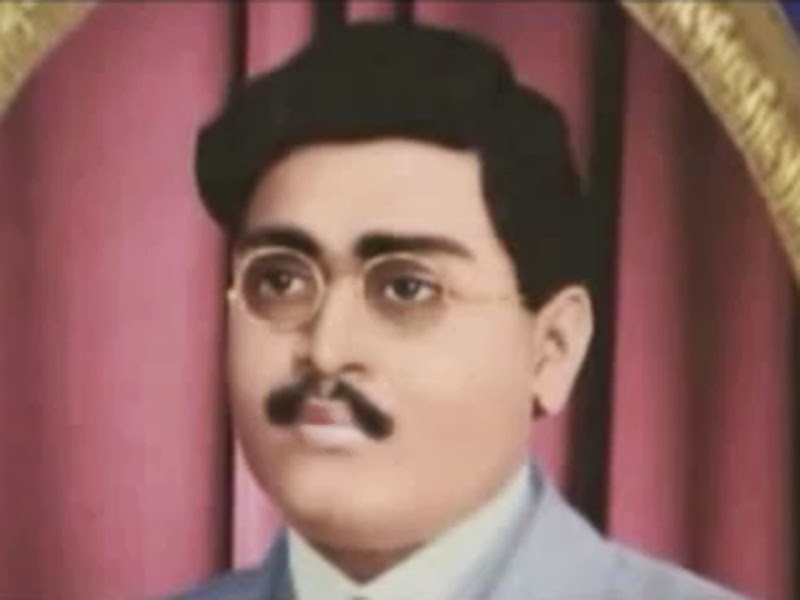
Abul Ala Maududi: An Existentialist History

Abul Ala Maududi

To most Pakistanis and to those who have been associated with various Islamic political outfits in countries like Egypt, Indonesia, Syria and Malaysia, Abul Ala Maududi is to 'Political Islam' what Karl Marx was to Communism.

Both western and South Asian historians have described him as one of the most powerful Islamic ideologues of the 20th century, whose ideas and writings went on to influence a vast number of Islamic movements in the Muslim world.

For example, the well-known American journal, The New Statesman, in its July 2013 issue, suggested that the impact of Maududi's ideas can be found in modern Islamic movements such as the Muslim Brotherhood (first formed in Egypt) and similar outfits across the Muslim realms, all the way to the more aggressive postures of men like Osama Bin Laden, the founder of Al Qaeda and once the most wanted terrorist in the world.

Ambitions and Achievements


In Pakistan, Maududi is mostly remembered as an Islamic scholar who founded the Jamaat-i-Islami (JI). But he also still remains a controversial figure here. To the left and liberal segments, he is remembered as the man who let the US use JI (during the Cold War) to undermine leftist and progressive politics in Pakistan,

whereas many Islamic parties opposed to the JI once went on to declare him to be a religious innovator who attempted to create a whole new sect.

He arrived in Pakistan from India as a migrant and scholar with the ambition to turn what to him was a nationalistic abomination into becoming a 'true Islamic state' based on the laws of the shariah.

Maududi had formed his party in 1941 like a Leninist outfit in which a vanguard and select group of learned and 'pious Muslims' would work to bring an 'Islamic revolution' and do away with the forces of what Maududi called modern-day jahiliya (socialism, communism, liberal democracy, secularism and a faith 'distorted by innovators').

To that end, he began to lay down the foundations of what came to be known as 'Islamism' — a theory that advocated the formation of an Islamic state by first 'Islamising' various sections of the economy and politics so that a fully Islamised polity could be built to launch the final Islamic revolution.

Maududi's theories in this context attracted certain segments of Pakistan's urban middle-classes and was also adopted by Egypt's Muslim Brotherhood, which tried to jettison the process through a 'jihad' within Egypt.

Not only did Maududi and his party face resistance from leftist groups, it also entered into a long tussle with Ayub Khan's secular/modernist dictatorship (1958-69), and with the ZA Bhutto regime, which was based on populist socialism (1971-77).

Maududi was also taken to task by the Jamiat Ulema-i-Pakistan, which accused the JI of creating a separate Muslim sect called 'Maududiat'.

Nevertheless, Maududi's ideas were eventually adopted by General Ziaul Haq, who had pulled off a successful military coup in July 1977 and then invited Maududi to help him shape policies to help make Pakistan a 'true Islamic country' run on 'Nizam-e-Mustafa.'

The course charted by Zia eventually mutated into becoming a destructive and highly polarising legacy that the state, politics and society of Pakistan has been battling with till this day.

But the irony is that none of what went down in the name of faith and 'Islamisation' during and after the Zia dictatorship was witnessed by the ideologue who had first inspired it, because Maududi passed away in 1979.

Not an all-out conservative — Maududi's existential journey


In all the noise that Maududi's career as a scholar, ideologue and politician generated, what got lost was the crucial fact that unlike most of today's Islamic scholars and leaders, Maududi did not emerge from an entirely conservative background.

His personal history is a rather fascinating story of a man who, after suffering from spats of existential crises, chose to interpret Islam as a political theory to address his own dilemmas.

He did not come raging out of a madressah, swinging a fist at the vulgarities of the modern world. On the contrary, he was born into a family in the town of Auranganad in colonial India that had relations with the modern and enlightened Muslim scholar, Sir Syed Ahmed Khan.

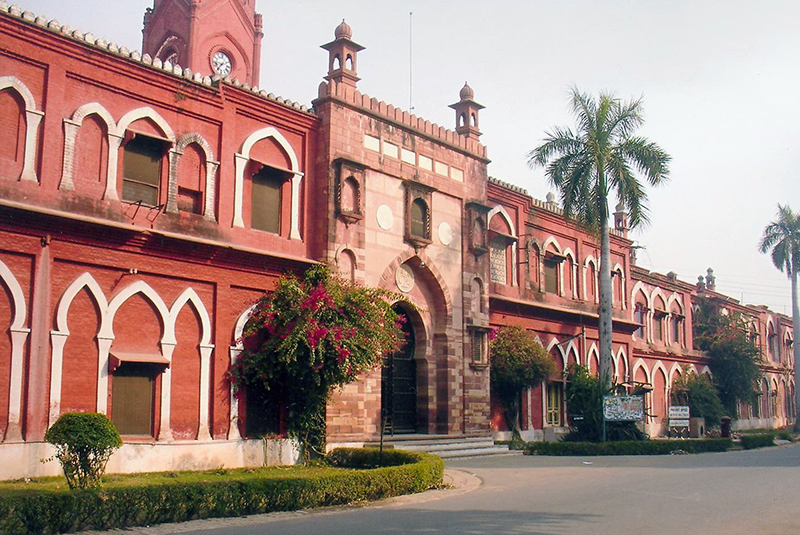
Syed Ahmed Khan was one of the earliest architects of Muslim Nationalism in India — a nationalism that attempted to create a robust Muslim middle-class in India that was well-versed in the sciences, arts and politics of Europe, as well as in the more rational and progressive understanding of Islam. It was for this very purpose that he formed the MAO college (later known as Aligarh University).

The Aligarh University that was formed by Sir Syed Ahmed Khan to modernise Muslim education in India.


Syed Ahmed convinced Maududi's father, Ahmed Hassan, to join the college against the wishes of Maududi's conservative paternal grandfather.

Incensed by the fact that his son had begun to wear 'Western clothes' and play cricket, Hassan's father pulled him out of the college and got him lectured by various clerics and ulema on how he was going against his faith by 'being overwhelmed by western lifestyle.'

Hassan soon renounced everything that had attracted him at the college and became extremely conservative and religious. When Maududi was born (1903), Hassan pledged not to give his son a western education.
So Maududi received his early education at home through private tutors who taught him the Quran, Hadith, Arabic and Persian. At age 12 Maududi, was sent to the Oriental High School whose curriculum had been designed by famous Islamic scholar, Shibli Nomani.

Apart from teaching Islamic law and tradition to the students, the school also taught Mathematics and English. Maududi then moved to an Islamic college, Darul Aloom, in Hyderabad. But he had to cut short his college education when his father fell sick and he had to travel to Bhopal to visit him. In Bhopal, the young Maududi befriended Urdu poet and writer, Niaz Fatehpuri.

Fatehpuri's writings and poetry were highly critical of conservative Muslims and the orthodox Muslim clergy, and on a number of occasions, various ulema had declared him to be a 'heretic.' But Fatehpuri soldiered on and had already begun to make a name for himself in Urdu literary circles when he met Maududi.

Inspired by Fatehpuri's writing style, Maududi too decided to become a writer. In 1919, the then 17-year-old Maududi moved to Delhi, where for the first time he began to study the works of Syed Ahmed Khan in full. This led to the study of major works of philosophy, sociology, history and politics by leading European thinkers and writers.

Maududi is said to have spent about five years reading books and essays authored by famous European philosophers, political scientists and historians, and he emerged from this vigorous exercise a man who claimed to have found the reason behind the rise of the West (and the fall of Muslim empires).

By now, he had also begun to write columns for Urdu newspapers. In one of his articles, he listed the names of those European scholars whose works and ideas, according to him, had shaped the rise of Western civilisation. The scholars that he mentioned in his list included Russian materialist philosopher, Hegel; British economist, Adam Smith; revolutionary French writers, Rousseau and Voltaire; pioneering evolutionist and biologist, Charles Darwin and many others.

With this article, he began to shape a narrative through his columns in which he emphasised the need (for Muslims) to study and understand Western political thought and philosophy and to 'master their sciences.' He said that one could not challenge anything that one did not understand.
 
It was also during this period that Maududi began to exhibit an interest in Marxism. At age 25, he became an admirer of the time's leading Marxist intellectual in India, Abdul Sattar Khairi, and then befriended famous progressive Urdu poet, Josh Malihabadi.

The young Maududi (1927)


 By the early 1930s, Maududi was living the life of a studious young man and journalist who also enjoyed watching films in the newly emerging cinemas of India and listening to songs. He married an independent-minded girl, Mehmuda, who was educated at a missionary school in Delhi, wore modern dresses and owned her own bicycle! There was no bar on her to wear a burqa.


 Despite all this, Maududi did retain some link with his past as the son of a very conservative man. In his quest to revive the lost tradition of Muslim intellectualism, he had also come close to India's main party of Sunni Deobandi Muslims, the Jamiat Ulema-i-Hind (JUH).

But at the same time, he also expressed admiration for the political and spiritual leader, Mahatma Gandhi. Though he never joined Gandhi's Indian National Congress (INC) himself, he did urge other Muslims to join it in his articles. He also authored biographies of Gandhi and another Congress ideologue, Pundit Malaviya.
Maududi was greatly dismayed by the breakup of the Ottoman Empire in Turkey, and he blamed Turkish nationalists for it. When INC began to talk about an 'Indian Nationalism', something snapped in Maududi.

He had devoured every book on Western philosophy and history, but when the Ottoman Empire collapsed at the hands of Turkish nationalists, Maududi realised he had been highly underrating the power of modern nationalism all this time. This was one European concept he was not too familiar with.

Disenchanted by the Congress' Indian Nationalism and JUH's alliance with the party, Maududi retreated to the life of a husband who spent most of his time with his family, books, the occasional film and classical and semi-classical songs performed on stage.

 In 1938, he bumped into Manzoor Nomani, a prominent Islamic scholar, who admonished him for distancing himself from his father's legacy, for not having a beard and living the life of a rudderless Muslim.

Already disappointed with the way the concept of nationalism was taking root in the minds of the Hindus and Muslims of India, Maududi retired back to his library, but this time to study Islam.

He now emerged with the theory that it wasn't really the greatness of modern Western thought that had been entirely responsible for the rise of European political power, but it was due to lack of conviction of the Muslims to practice their faith in the right manner that had triggered their fall and made room for European powers to enter.


 In 1937, he vehemently attacked the INC's nationalism, accusing it of trying to subjugate the Muslims of India, but by the early 1940s he was being equally critical of Jinnah's All India Muslim League and of Muslim Nationalism.

He declared the League to be 'a party of pagans' and 'nominal Muslims' who wanted to create a secular country in the name of Pakistan.

Maududi's vehement attacks could not stop the sudden momentum that the League gained in 1946 and that helped it form an independent Muslim country in 1947.

In another ironic move, Maududi decided to leave India and head for a country that to him was an abomination and abode of nominal Muslims and the jahiliya. He began his political career in Pakistan in 1949, and it lasted on till 1979, when he passed away from illness in a US hospital. His funeral in Lahore was attended by thousands of admirers.

The many Maududis


Writing in the 'Princeton Encyclopedia of Islamic Political Thought', Irfan Ahmed suggests that there was not one Maududi but many.

By this, he meant that as a scholar and ideologue, Maududi's views were often derivatives of phases in his existential journey; one that saw him depart from the conservatism his father had tried to impose upon him and wholeheartedly embrace the freshness of European philosophical and political thought.

Maududi then bounced between Indian Marxism and the anti-colonial stances of Gandhi and Deobandi ulema (JUH), before settling for a quiet urban middle-class family life. But incensed by the rise of Muslim Nationalism, Maududi finally found his calling in the project of interpreting Islam's holy texts in a political light, and emerging with a complex theory that we now call Political Islam (aka 'Islamism').

Elements of organisational Leninism, Hegel's dualism, Jalaluddin Afghani's Pan-Islamism and various other modern political theories can be found in his innovative thesis, and that's why his thoughts not only managed to appeal to modern conservative Muslim movements such as the Muslim Brotherhood and populist youth outfits such as the Islami Jamiat Taleba, but even the mujahideen who fought Soviet forces in Afghanistan all the way to the more anarchic (if not entirely nihilistic) ways of men such as Osama Bin Laden.

But the question is, had Maududi been alive today, which one of the many Maududis out there would he have been most comfortable with?

Wednesday, 31 December 2014

Cross-border firing injures two soldiers in Narowal: Chenab Rangers

This representative images shows security forces personnel guarding the border separating India and Pakistan. — AFP/File

SIALKOT: Cross-border firing between Pakistani border guards and Indian Border Security Force (BSF) personnel injured two soldiers in the Shakargarh sector of Narowal district on Wednesday, a Chenab Rangers spokesman said.


The injured included Naik Riaz Shakar and Lance Naik Safdar of Chenab Rangers, the spokesman said, adding that the exchange broke out ahead of a flag meeting ceremony in the sector.


Earlier in October and November, skirmishes at the Indo-Pak border increased hostilities between the two countries with both accusing each other of initiating the firing.

Reportedly more than 20 people had lost their lives on both sides of the border.

Monday, 29 December 2014

2014: When Lollywood met Bollywood

Clockwise from top: Fawad Khan, Ali Zafar, Humaima Malick and Imran Abbas


Indian cinema is one of the most flourishing industries found today and this year, many Pakistani actors also tried their luck in one of the world's most prolific film industries.

2014 had its standout moments for our beloved celebrities working in Bollywood and here's what they have to say about it.

Ali Zafar:

Ali Zafar in a scene from 'Kill Dil'. – Publicity photo

Ali Zafar leads the pack by being one of the first Pakistani actors to have accomplished relative success in a cutthroat Bollywood.
 
Ali ventured from working as a sketch artist in the Pearl Continental hotel, Karachi, to becoming a rock star and has now comfortably transitioned into a versatile actor having done a wide array of roles such as his debut in the satirical Tere Bin Laden to more romantic and comedic roles such as in Mere Brother Ki Dulhan and Total Siyappa.

However, in 2014, the heartthrob set out to redefine himself with Shaad Ali's Kill Dil in which he starred alongside big banner names like Ranveer Singh, Parineeti Chopra and Govinda.

Playing the role of a gangster, Ali has consciously tried to deviate from his rom-com image. The film led to mixed reviews, but Ali achieved what he had set out to do.

Speaking to Dawn, Ali tells us about his time on the Indian soil:
Was working in India a goal you had in mind from the beginning of your career or did it just happen when the opportunity presented itself?

Ali Zafar (AZ): Yes, it was a goal from the beginning.
If you go back in time (1999), when I was in college, I did have aspirations to become an internationally renowned singer, but back then, there was no such concept of somebody crossing over like that.
However, for some reason, I always had faith in the idea that an artist should strive to go global.
Once I started to talk to people about this idea, I realised that at the time there were very few people in Pakistan who dreamt big or thought outside the box. Primarily, the goal was to do well locally, basing their success on the amount of shows they've done in the country.

For me, the goal was to break barriers and I had to learn the dynamics of the business so it took time.
In the last 60 years, we had people trying to make it big there [in India], but were not successful.
So to be the first successful actor in India was a conscious struggle and effort. I wanted to break that barrier for others to also enjoy its fruit. And I'm happy and content that it has happened.

How is audience reception different in Pakistan and India?

AZ: Although I'm an optimist, at the same time I am also a realist and we must be honest with ourselves: all the most popular artists in Pakistan got to that level once they ventured into the Indian market.
Yes, they were well-known and admired in Pakistan, but they became stars when they tapped into the Indian market.
The reason behind this is that in Pakistan, the entertainment industry has neither developed as an industry nor has the perception of an artist. It'll take time for society to evolve and learn to appreciate art and artists.
Bollywood gives its stars value and appreciation. I'm not saying we don't get admiration and importance at home; it was Pakistan and Pakistanis alone who gave a lot of such stars their initial recognition, such as Rahat Fateh Ali Khan, Fawad Khan or Atif Aslam. However, to get to the next level, they had to make that leap and cross over to India.
There's no harm in accepting that our industry will take time to develop and it is working towards it. It's a process, a journey and it will eventually happen.


Share your favourite moment/memorable story from working in India.
AZ: I've always felt that when the masses are recognising you and appreciating you, such as the rickshaw or truck drivers, that's when you've become a celebrity and I love each and every one of my fans.
So when I was being driven through a small, not very posh, community in Mumbai, I got noticed and the entire community gathered around the car and started screaming my name and praising me and that was truly a touching moment for me.
The fact that they came out of their houses to just tell me they enjoy my work was a big moment for me.

Do you truly feel 100 per cent accepted across the border?
AZ: There's no black and white with this. There will always be people everywhere in the world who would accept certain ideas and some who would not.
I would say that a large percentage of people in India are accepting me, have [accepted me] right from the first film.
When Tere Bin Laden came out, people didn't go like, 'Where did this Pakistani come from?', they actually went out to watch the movie and I got a tremendous response from critics and audiences for my work .

Who is that one person from Pakistan, and that one person from India who should work across the border, but hasn’t so far and why?
AZ: Mahira Khan is one individual who I feel is very talented and should work in India. She carries herself well. As far as someone from India working in Pakistan, I think Deepika Padukone should be involved in a project.

Humaima Malick:

Humaima Malik. 

Humaima made her Bollywood debut earlier this year opposite Emraan Hashmi in 'Raja Natwarlal'.

The actor, who rose to fame after her performance in Shoaib Mansoor's Bol, gave a bold performance which met equal parts criticism and praise.
After Raja Natwarlal, Humaima has signed up for three films in Bollywood and already calls India her "second home".
The performer, who has also been making rounds on social media because of her on point fashion choices, speaks about working across the border:

Was working in India a goal you had in mind from the beginning of your career or did it just happen when the opportunity presented itself?
Humaima Malick (HM): I've never made goals in my life regarding my career because I feel like whatever you plan, sometimes it doesn't happen and sometimes, God has bigger plans for you.
When Bol released internationally, including in India, opportunities started coming in but at that time, I didn't really take them seriously nor did I have any plans to venture out into Bollywood.
When I got the script for Raja Natwarlal, I liked it. I thought it was different and not a typical Emraan Hashmi film. I liked the director as well as the production house and I figured I'd have good fun working with this team so I just went ahead with it.

How is audience reception different in Pakistan and India?
HM: India is a nation obsessed with cinema. They love their artists, they respect them so much.
Their celebrities are more famous than their politicians. If you go to Bombay, you'll see so many people waiting outside Mannat (Shahrukh Khan's house) or Jalsa (Amitabh Bachchan's house) just to catch a glimpse of them.
This is what we call stardom. People there respect and acknowledge art a lot.
Unfortunately, our nation has more pressing concerns such as immense poverty and security issues due to which entertainment takes a backseat.

Share your favourite moment/memorable story from working in India.
HM: This entire past year; the release of Raja Natwarlal; the shooting process throughout with my amazing team; all of it was very memorable and has brought me immense happiness.

Do you truly feel 100 per cent accepted across the border?
HM: I don't want to be accepted anywhere [laughs].
I'm an artist. I work to be appreciated, I work for the people who love me.
I'm a peace ambassador, I always say that actors are peace ambassadors so there are no boundaries and no country limits for us.
I will go wherever my talent and my art will take me and continue to work without thinking about gaining acceptance.

Who is one person from Pakistan, and one person from India who should work across the border, but hasn’t so far and why?
HM: From the Pakistani industry, I'd say Shaan. Whereas from India, I want Salman Khan to work in Pakistan. He's the biggest star in India and he has a huge fan following so why not?

Imran Abbas:
Imran Abbas. – Courtesy photo


Model turned actor Imran Abbas is regarded as a surprising and welcome addition to the Bollywood bandwagon.
After working in television serials like Mera Naseeb, Khuda Aur Mohabbat and Dil-i-Muztar, the young actor smoothly shifted focus to movies.
His first Pakistani film was Yasir Nawaz's Anjuman which failed to impress most of the audience.
However, that did not hinder the actor's progress as he was soon after offered a role in Vikram Bhatt's monster thriller Creature 3D opposite Bipasha Basu.
The Malaal actor talks to Dawn about his experience in Bollywood thus far:

Was working in India a goal you had in mind from the beginning of your career or did it just happen when the opportunity presented itself?
Imran Abbas (IA): No, I neither ever thought, nor harboured a goal to work in India.
Actually, acting itself was never an ambition. Basically, I am a trained architect and initially I just received a flood of acting offers which just kept on pouring in.
I don’t plan these things and never really imagined I would work in India.
But working in Bollywood is both a huge responsibility and achievement as it is a huge industry which offers one wide exposure.
Its actors have made names for themselves worldwide, so being part of this industry has been a big honour and one should not be embarrassed or ashamed to admit this.

How is audience reception different in Pakistan and India?
IA: I think the reaction and the reception has been similar in both countries. Everyone appreciates good work.
I have received great respect in Pakistan from TV audiences and probably because of that adulation in Pakistan I have received recognition in India. If I had not appeared on TV in Pakistan, perhaps no one would have recognised me in India so I am truly grateful for the recognition Pakistan has given me.
I am definitely garnering good reviews in India, which can be seen by the standard of projects I am being offered and the ones I'm already doing. This can be witnessed by the fact that I have been offered a couple of mainstream Bollywood projects and by the fact that I worked with Muzaffar Ali sahib, which I think is a big achievement as he is a great director who has worked with all of India’s screen legends.

Share your favourite moment/memorable story from working in India.
IA: I think working with Muzaffar Ali sahib was the apex of memorable experiences. Growing up as a classical singer myself, I used to listen ardently to the songs from his directorial venture Umrao Jaan.
It was always my wish to meet and work with a legend who has knowledge about classical music, about acting, about beauty; who knows about culture and traditions and myriad civilisations as well as literature.
I am also an art student so in my mind’s eye there is no one who fills all these attributes more than Muzaffar Ali sahib.
Other memorable moments which I will always remember include receiving compliments from legendary actors such as Dilip Kumar. Also meetings with Lataji (Mangeshkar) and Ashaji (Bhosle) remain special moments.
The interludes with these and others whom I grew up watching and admiring make up my most memorable moments.

Do you truly feel 100 per cent accepted across the border?
IA: No. It’s not like that. No one is ever accepted 100 per cent.
In a neighbourhood of 100,000 inhabitants, not all of those 100,000 will like you. There will be those who like you and those who don’t.
Anywhere in the world no actor or any human being for that matter receives 100 per cent acceptance. No one is ever totally happy with you or your myriad efforts and achievements.
Having said all of that, even though I have not garnered 100 per cent acceptance, whatever I have done is plenty and I would love to receive more love from India!

Who is one person from Pakistan, and one person from India who should work across the border, but hasn’t so far and why?
I think if the late actor Moin Akhtar had worked in India he would have been even more heralded and lauded than he already is. There was never such a brilliant actor as him in Pakistan nor is there now. I think he was one of the finest actors in the subcontinent.
I believe that Hina Dilpazeer would be much appreciated in India because she has an eclectic range and is able to perform diverse roles admirably, as well as Bushra Ansari who is similarly versatile.
I really hope that Amitabh Bachchan, who is a great actor and star comes to Pakistan and works in a project here.

Fawad Khan:
Fawad Khan. – File photo

Fawad Khan worked his way into the hearts of the Indian audience with incredible ease when his show Zindagi Gulzar Hai aired on India's Zindagi TV, followed by Humsafar, which is regarded as the most successful show in the history of Pakistani television.

He made his debut in Shashanka Ghosh's remake of the 1980 Hrishikesh Mukherjee-directed classic, Khoobsurat opposite Sonam Kapoor and became an A-lister overnight.
Although the film itself was an average grosser at the box office, it solidified Fawad's presence in the industry and along with his brooding looks, his acting chops were also noticed.
Unfortunately, the actor was not available to comment on his Bollywood experience.

Sunday, 28 December 2014

A new vision of India – 100% Hindu

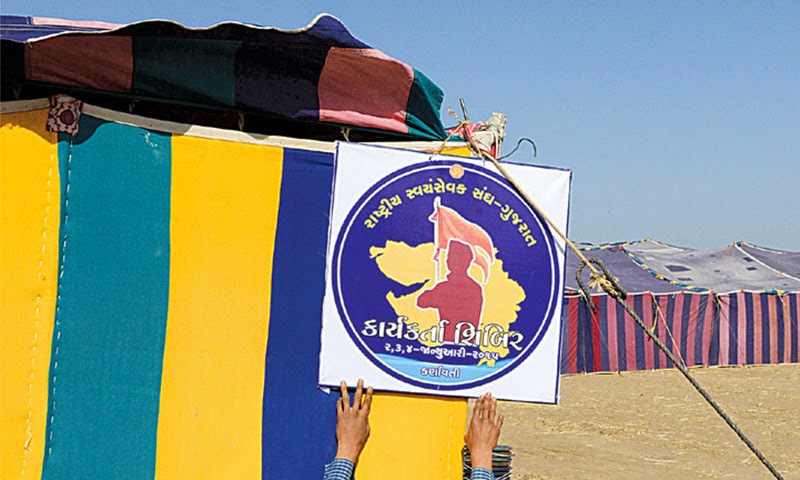
A worker arranges a placard of the RSS outside a tent at Dastan Farm on the outskirts of Ahmedabad where a three-day Karyakarta Shibir is to take place from Jan 2-4, in which some 25,000 RSS volunteers from across Gujarat are expected to participate. — AFP

NEW DELHI: This month, the Rashtriya Swayamsevak Sangh, India’s powerful, male-only Hindu nationalist outfit, finally played a card it has long held in its hand. It announced an intensive conversion programme to recover its “lost property” in India, feeding the dream of its cadre and allied organisations of an India that is nothing less than “100 per cent Hindu”.

The RSS has visibly grown in power and ambition in the seven months since the arrival of a new government — unsurprisingly, as it counts among its past members the current prime minister, Narendra Modi, as well as many old and new chief ministers in the states. With this carefully calculated provocation under a regime sympathetic to its ideology, the non-governmental organisation is seeking victories in many arenas.

In the realm of law, the RSS wants the passage of a stringent nationwide bill that would ban religious conversions. In the public sphere, it has arrogated the right to pronounce not just on the future of minorities in India but that of India’s Hindu majority as well. In the war of the religions, it seeks to spread the news that there is now a Hindu fundamentalism eager to goad and trump well-established Christian and Islamic

fundamentals in India and around the world. And among its own vast cadre, it has generated the sense that it, much more than the government of the day or the diverse institutions of civil society and business, holds the keys to India’s future.

But let’s consider conversion as a recurring question in Indian history, one that reveals the tensions between a religious society and a secular state, between conservative and liberal adherents of a religion, between majorities and minorities in a multicultural milieu, and between religions that have a history of proselytising and those that don’t.

The RSS’s new emphasis on conversion actually represents an about-face for the organisation, which has for decades condemned missionary activity by Muslims and Christians in India. In so doing, the RSS often points out that Hinduism suffers because it has historically never been a proselytising religion (its identity is partly based on being born into a pre-existing caste order). Therefore, if religion were to become a sort of free market in a multi-faith country such as India, Hinduism could only stand to lose followers, not gain any.

As a Hindu, I have some sympathy with this viewpoint. Missionary activity has always seemed to me unacceptably crude and arrogant, not only in its conviction that there is a single truth that must be propagated, but also in its contempt for two of the forces that most strongly influence religious belief: the accident of birth in a certain religion, which is then followed by many years of socialisation into its worldview.

To be sure, I respect an individual’s freedom not only to practise his or her faith but also to change it, as allowed in India by the constitution. But shouldn’t this follow from a person’s own dissatisfaction or personal struggle, not as an outcome of the outreach work or material inducements of an organised religion? I even find myself in sympathy with Mahatma Gandhi’s unusual idea that it’s best that a person rule out the option of changing his religion and instead live through his or her quarrels with it (as Gandhi very vividly did).

So if the RSS’s new and crude campaign were aimed at simply drawing attention to the absence of a level playing field in India on the issue of conversion, as well as to generate the necessary debate leading to the passage of such a bill, I could see the point of it. But in truth, even if such a bill were passed, the RSS would insist that it would nevertheless not be bound by the bill’s terms. That’s because the present aggressive campaign of the RSS is, in its own eyes, not about conversion but about reversion: the return, after many generations, of Christians and Muslims whose forefathers were once Hindu but were converted during India’s centuries under Islamic and colonial rule.

What the RSS seeks, then, is a new disequilibrium in which no other religious organisation would have the right to convert people. No wonder it salivates at the prospect of a future India in which, by generating a consensus against the missionary activity of other religions, it can engineer a society that’s 100 per cent Hindu.

And we shouldn’t lose sight of the even more slippery and sinister part of the RSS’s sinister agenda: the simultaneous conversion of a few hundred million people from Hinduism to Hindutva, the rancorous, intellectually and morally impoverished version of Hinduism that the RSS propagates.

This is a dour doctrine that — like other religious fundamentals — makes no distinction between myth and history, science and religious belief, and often comes close to caricature. It believes that Hinduism is a thought system perfect from its very origins, that all the problems of modernity and history were foreseen by Hindu sages 2,000 years ago, that all modern scientific achievement was prefigured in Hindu thought, that Indians of all faiths are “culturally Hindu”, that India’s four-fifths Hindu majority is under threat from minorities, and that all Hindus should fall in line with a singular interpretation of Hindu tradition controlled by a central authority. That body would be — surprise, surprise — the RSS.

What’s the view of the Modi government on all of this? In the firestorm that has erupted around the conversion issue, one man’s refusal to comment has come to seem as meaningful as any argument: Prime Minister Modi, who in recent months has taken his message of development and an economically resurgent India to many parts of the world, has remained shamefully silent. (As usual, his friends in the media have found inventive ways of coming to his defence.)

Perhaps this non-gesture reflects Modi’s divided allegiance between the oaths and responsibilities of his present post and the convictions and prejudices of his often murky past. But there’s no getting past the truth that the evasion by this allegedly firm and decisive leader — the holder of the largest majority in India’s parliament in three decades — of the conversion debate holds profound implications for the freedom and future of all of India’s 1.2 billion people.

Saturday, 27 December 2014

PDP, NC, Congress should resist BJP move to form government in Jammu and Kashmir, says CPI (M)

Newly-elected CPI(M) MLA in Jammu and Kashmir, MY Tarigami, on Saturday asked NC, PDP, Congress and independents to "unitedly resist" any move by the BJP to form a government in the state.
"Our apprehensions are real because the past history of RSS is there. The BJP today is not BJP, it is pure and simple RSS and unlike the BJP of old times," he said.

"My appeal to the political leadership  in Jammu and Kashmir, those who are having a good number of support in the legislature like PDP, NC and Congress and other independents as well, please try to understand the serious implications," he said. Tarigami said he had not received any invitation from any party to support it.

Tarigami claimed some years back, in its Haryana conclave, RSS had adopted a resolution for separate statehood for Jammu and allying with such a party will be a "historic blunder of disastrous magnitude".
"I want to caution those who are holding parleys with the RSS on government formation, that RSS agenda of separate state for Jammu virtually will lead to the bifurcation of the state. "Are they ready to face it?" he asked. The CPI(M) leader said he was in favour of a non-BJP secular government in the state and was in talks with other independents over the issue.

"I am in favour of a non-BJP secular government in the state. May be all (secular) parties or few only, but non-BJP secular parties. "Hakim Yaseen, Engineer Abdul Rashid and me are talking together and discussing issues and we have the commonality that there are other options which should be explored. And which can at least promote the unity of Jammu, Kashmir and Ladakh.

"We (Tarigami, Yaseen and Rashid) are of the opinion that there must be a non-BJP secular government in the state. There is a strong possibility of a non-BJP secular government...the numbers are not short," he said. Appealing to the secular parties to rise to the occasion and to understand the "dangers ahead", he advised them to see the larger interests of the state and not just their "partisan interests".

"My appeal to those who matter in the situation and have the electoral strength behind them, is to rise to the occasion and come out of their partisan interests," he said.

He said the RSS, in the garb of BJP, was trying hard to impose its agenda on the polity of the state and any such effort was fraught with "dangerous consequences" and "fatal" for the future of the state and integrity of the country.

"The results of the Assembly elections are complicated and fragmented and it is a highly polarised mandate. What we are learning from whatever has come in media, it seems BJP is seriously trying and in fact RSS is virtually trying hard to impose its agenda on the polity of Jammu and Kashmir.

"I think it will have serious implications for the state and the country as a whole," the state secretary of CPI(M) told reporters. Tarigami, who won the Assembly poll from south Kashmir's Kulgam seat for the fourth time in a row, said, "had it been just a question of government formation, we would not have been concerned this much".

"But looking at the history of RSS and its agenda, especially about the issues of Jammu and Kashmir, if their interference increases in government formation, the results will be serious," he said. The CPI(M) leader said if BJP was concerned, even a little, about the unity and integrity of the country, then the party must care about the sensitivities in the state.

"If only partisan interests are kept in mind and efforts are made to impose their political agendas, I fear the hard earned peace process will be hit and the country's integrity will bear the brunt," he claimed.